
No products in the cart.
Return To Shop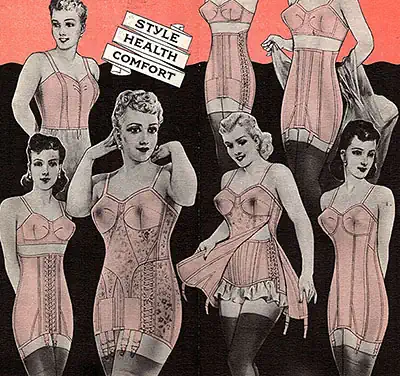
1930s Girdles: Shaping the Modern Silhouette
Introduction: The 1930’s Girdle
The 1930s marked a profound transformation in women’s fashion, signaling a departure from the slender, boyish “flapper” aesthetic that characterized the 1920s. This new decade ushered in a preference for a more natural, yet meticulously sculpted, feminine figure -enter the new style 1930’s Girdle.
The prevailing silhouette of the 1930s figure emphasized elongated lines, a subtly defined waist, and gently curved hips, necessitating a sophisticated evolution in foundation garments. The era’s distinctive bias-cut dresses, designed to gracefully drape and cling to the body, demanded an impeccably smooth and controlled under-layer to achieve their intended elegance and fluid movement.
In response to this evolving fashion landscape, the traditional corset, with its associations of rigidity and discomfort, began to transform into a more flexible and ostensibly modern garment known as the “girdle.”
This shift was more than a mere change in nomenclature; it represented a strategic rebranding by underwear manufacturers. The aim was to present a contemporary, less restrictive alternative that, while performing similar shaping functions, distanced itself from the perceived constraints of its Victorian predecessor.
The term “girdle” was deliberately chosen to evoke a sense of modernity and enhanced comfort, thereby aligning the product with the prevailing cultural ideals of 1930s fashion. This conscious effort allowed manufacturers to offer a product that still provided essential shaping and support—a necessity for the new bias-cut fashions—but framed it within the context of modern comfort and a “natural,” albeit subtly sculpted, figure.
This demonstrates how fashion, technological advancements, and marketing strategies converge to influence consumer behavior and redefine beauty standards, reflecting a deliberate alignment with the zeitgeist of the era.
Girdles were actively promoted as essential for women to achieve the desired slender silhouette, while also addressing emerging societal concerns about “sagging” bodies and maintaining a youthful appearance.
Defining the 1930s Girdle: Design and Form
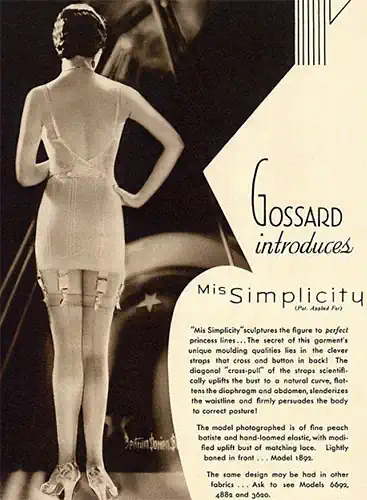
The fundamental purpose of the 1930s girdle was to create a fitted, elongated silhouette that highlighted slim hips and a subtly suggested waist, rather than a severely cinched one.
This foundational garment was engineered to flatten the abdomen and narrow the hips, providing an impeccably smooth canvas beneath the era’s sleek, bias-cut dresses and precisely tailored suits.
The introduction of padded shoulders by couturière Elsa Schiaparelli further accentuated the perceived slimness of the waistline, making the girdle’s smoothing effect even more critical for achieving the decade’s overall desired form.
The overarching aesthetic goal was an “elongated figure” characterized by “waists at the waistline, breasts that were small but lifted, and flat tummies with narrow hips”.
Common Lengths
Girdles of the 1930s were generally designed to extend “long at the thigh” and reach upwards to a point “between directly under the bust and the waist”.
While earlier corsets from the 1910s could be quite restrictive and extend to mid-thigh, 1930s girdles were somewhat “shortened up some” and critically incorporated elastic for enhanced comfort and practicality. This adaptation allowed for greater ease of sitting and movement, a significant improvement over their predecessors.
A specific 1930s girdle pattern provides a concrete measurement for its typical extension, indicating a skirt length of 39-41cm at the center front.
Construction Details
The construction of 1930s girdles showcased a blend of traditional techniques and modern innovations to achieve both control and comfort.
- Seams and Panels: Angled seams were a prevalent design feature, often incorporating elasticated inserts. These elastic panels were crucial for providing flexibility and allowing for the freedom of movement necessary for the era’s fluid outer garments. Some designs were quite intricate, featuring multiple panels – for instance, a 10-panelled 1930s girdle pattern with four gores or gussets to achieve precise and flattering body shaping.
- Closures: Side hook-and-eye fastenings were typical for many girdles. A key modern advancement was the integration of “invisible zipper closures,” which further enhanced the garment’s sleekness and seamless appearance beneath clothing. However, the outbreak of World War II in 1939 significantly impacted material availability. Metal and rubber were prioritized for the war effort, leading to limitations on steel boning and hook-and-eye closures. This scarcity sometimes resulted in a temporary shift towards less luxurious fabrics and the reintroduction of lace-up fastenings.
- Boning: Although less rigid than their Victorian predecessors, 1930s girdles still utilized boning for targeted support and shaping. Flat steel bones were commonly employed, sometimes featuring a nylon coating to prevent rust, a practical innovation that improved durability. Some designs incorporated “hidden, heavily boned inner girdles with elasticated panels” for enhanced control in specific areas. It is noteworthy that boning was often minimal below the hip, indicating a focus on smoothing the figure rather than constricting the lower body.
- Stocking Garters/Suspenders: An indispensable component of the 1930s girdle, these garments typically included four or more stocking garters (also known as suspenders). These were strategically positioned around the hem to securely attach and hold up hosiery, ensuring a smooth and wrinkle-free line down the leg, which was essential for the era’s elegant hemlines.
The evolution of the girdle’s design directly reflects a response to the changing demands of women’s lifestyles and fashion. The integration of elastic and more flexible construction elements allowed the girdle to provide the necessary smoothing and shaping for the new fluid outer garments while simultaneously offering greater freedom of movement.
This “freedom” was relative to earlier, more restrictive garments, but it was a key appeal of the “loosened dress” silhouette of the 1930s. This demonstrates a clear cause-and-effect relationship between societal shifts, such as women’s increasing participation in public life and sports, and fashion trends, like the adoption of bias-cut dresses, which together drove the functional design and material innovation of undergarments.
Key Design Features of 1930s Girdles
| Feature | Description |
| Silhouette | Fitted, long, emphasizing slim hips, a subtly suggested waist, and a lifted bust. |
Materials and Innovation: The Fabric of Control
The 1930s represented a truly revolutionary period for textile development, directly influencing the design, comfort, and widespread adoption of the girdle. The advancements in fabric technology were instrumental in shaping the decade’s distinctive silhouette.
Revolutionary Elastic Fabrics
Lastex: Developed in the late 1920s and becoming a “game changer” in 1931, Lastex was the pivotal elastic fiber of the era. Its introduction enabled the production of fine textured and knitted elasticated fabrics, most notably offering a “two-way stretch” that was immediately and lastingly popular. This unprecedented flexibility meant that women could “wear a girdle and move, bend, play sports, and look good in an evening gown”, marking a significant departure from the rigidity of earlier corsetry.
Rayon: Introduced in the 1930s, Rayon further enhanced the aesthetic appeal of girdles by bringing a “beautiful new finish” to satins, broches, and other elastic fabrics used for corsetry. This innovation made luxurious-looking materials accessible to the mass market, democratizing sophisticated undergarment styles and allowing for a more refined appearance beneath outer clothing.
Traditional and Supporting Fabrics
While elastic fabrics were at the forefront of innovation, traditional materials continued to play a crucial role in girdle construction. These included sturdy fabrics like coutil, cotton sateen, silk satin, and cotton twill. Many girdles utilized a combination of these more rigid fabric panels with strategically placed elastic inserts to achieve both targeted control and overall flexibility.
Boning Materials
Steel boning, often with a protective nylon coating to prevent rust, had largely replaced whalebone by the early 20th century, making corsets and subsequently girdles more cost-effective and widely available. Flat steel bones were specifically incorporated for targeted shaping and support in various girdle designs, providing structure where needed without excessive rigidity.
Impact of Wartime Rationing
The declaration of World War II in 1939 had a notable impact on material availability. Metal and rubber were prioritized for the war effort, leading to limitations on steel boning and hook-and-eye closures. This scarcity sometimes necessitated a return to lace-up fastenings and the use of less luxurious, more functional fabrics for undergarments, demonstrating how external geopolitical factors can directly influence fashion design and material choices.
The pivotal role of Lastex and Rayon in defining 1930s girdles, with their emphasis on “two-way stretch” and “beautiful new finish,” illustrates how new technologies can enable entirely new fashion silhouettes. These materials directly facilitated the sleek, bias-cut fashion of the 1930s by providing undergarments that offered both control and unprecedented flexibility.
Conversely, the wartime rationing of metal and rubber forced designers to adapt, leading to simpler designs, alternative fastenings, and less luxurious fabrics. This dynamic interplay between material science, industrial capacity, and geopolitical events profoundly shaped the characteristics and evolution of 1930s girdles, revealing how external factors can dictate internal design.
Function and Purpose: Beyond Aesthetics
The 1930s girdle served multiple critical functions that extended far beyond merely altering the aesthetic appearance of the body, reflecting the practical needs and evolving fashion demands of the era.
Foundation for Outerwear
Its most crucial role was to provide a smooth, streamlined, and unblemished foundation for the era’s form-fitting outerwear. This was particularly vital for bias-cut dresses, which clung to every curve, and tailored suits that were designed to nip in at the waist and curve closely over the hips. Without a proper foundation garment like the girdle, outer bodices would have constantly wrinkled, ridden up, or revealed “figure flaws” that would disrupt the sleek lines of the fashionable silhouette.
Tummy and Hip Control
Girdles were specifically engineered for “tummy and hip control,” effectively flattening “problem areas” and contributing to the desired “flat tummies with narrow hips”. They aimed to smooth out “unlovely” bulges, providing a sleek contour rather than drastically constricting the figure, which was a key distinction from earlier corsetry.
Abdominal Support and Posture Improvement
Beyond purely aesthetic considerations, the girdle also fulfilled a practical, health-related function. Girdles were actively encouraged for “abdominal support,” a benefit particularly relevant for women engaged in arduous jobs or long hours, reflecting a functional emphasis during the economically challenging crisis era. Certain girdle designs, especially those incorporating steel boning at the back, were also lauded for their ability to help with posture correction, contributing to the upright and elegant bearing favoured in the 1930s.
Famous 1930s Girdle Brands
The 1930s saw several prominent brands dominating the foundation garment market. Gossard, for example, held a central market position throughout the decade. Other notable manufacturers that produced corsetry and girdles included Playtex, St. Michael, Triumph (which continued to evolve with the times), Berlei, Spencer, and Camp (some of which struggled with diminishing clientele in later decades).
Brands like Spirella, Charis, and Jenyns, while successful in their time, eventually vanished. Roussel was particularly known for its innovative elastic ‘tricot’ construction, which featured “no bones at all” and emphasized freedom of movement, appealing to the ideal of a less restrictive garment.
The Girdle’s Enduring Legacy
The girdle’s evolution in the 1930s laid significant groundwork for modern shapewear, demonstrating how undergarments are inextricably linked to prevailing fashion trends, technological advancements, and broader societal changes in women’s roles and perceptions of the body.
The enduring market for “retro” girdles proves that certain aesthetic ideals and comfort-control balances achieved in the 1930s were so effective that they continue to be reinterpreted and desired in contemporary fashion, cementing their lasting legacy beyond mere historical interest.
The effectiveness of these designs in achieving a balanced silhouette combined with the comfort afforded by new materials, created a blueprint for shapewear that transcends specific historical periods.
Where can you buy Vintage Inspired Girdles in the UK?
Swanky Pins offers “retro” and “vintage-inspired” girdles & shapewear which aims to replicate the hourglass silhouettes and foundational principles of the influential mid-century eras.
Vintage Girdles from Swanky Pins
Longline Girdle with Suspenders 1950’s style in Satin and Power Mesh
Original price was: £38.99.£34.75Current price is: £34.75.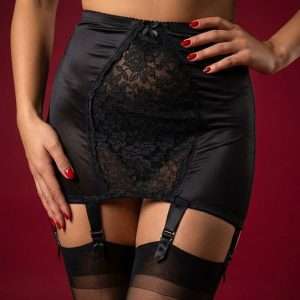
Black Lace Front Longline Suspender Girdle
£35.95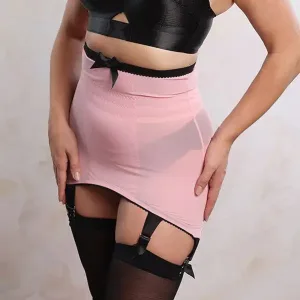
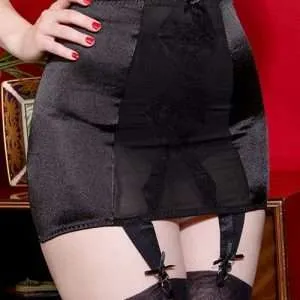
High Waist Open Bottom Girdle with Suspenders in Pink & Black
£44.95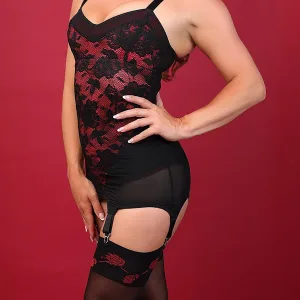
Corselette with Suspenders in Black Lace with Red Underlay
£54.95


About author

Related posts

When it comes to vintage-inspired lingerie, few garments cause as much confusion as the basque, the corset, and the corselette. These structured undergarments all shape... Continue reading
“Summary: Looking for vintage style sleepwear inspiration? This guide examines the key differences between 1940s and 1950s women’s loungewear. Learn about the transition from 1940s... Continue reading
The Hourglass Silhouette At the heart of 1950s lingerie was the desire to sculpt the perfect hourglass figure. Christian Dior’s famous “New Look” of 1947... Continue reading
The 1930’s Girdle 1930s girdles replaced the rigid, heavily boned corsets of previous eras and tended to feature angled seams, hidden boning, and side hook-and-eye... Continue reading
At Swanky Pins, we love the bullet bra – if there’s one piece of vintage lingerie that truly captures the essence of 1950s glamour, it’s... Continue reading




Add comment